
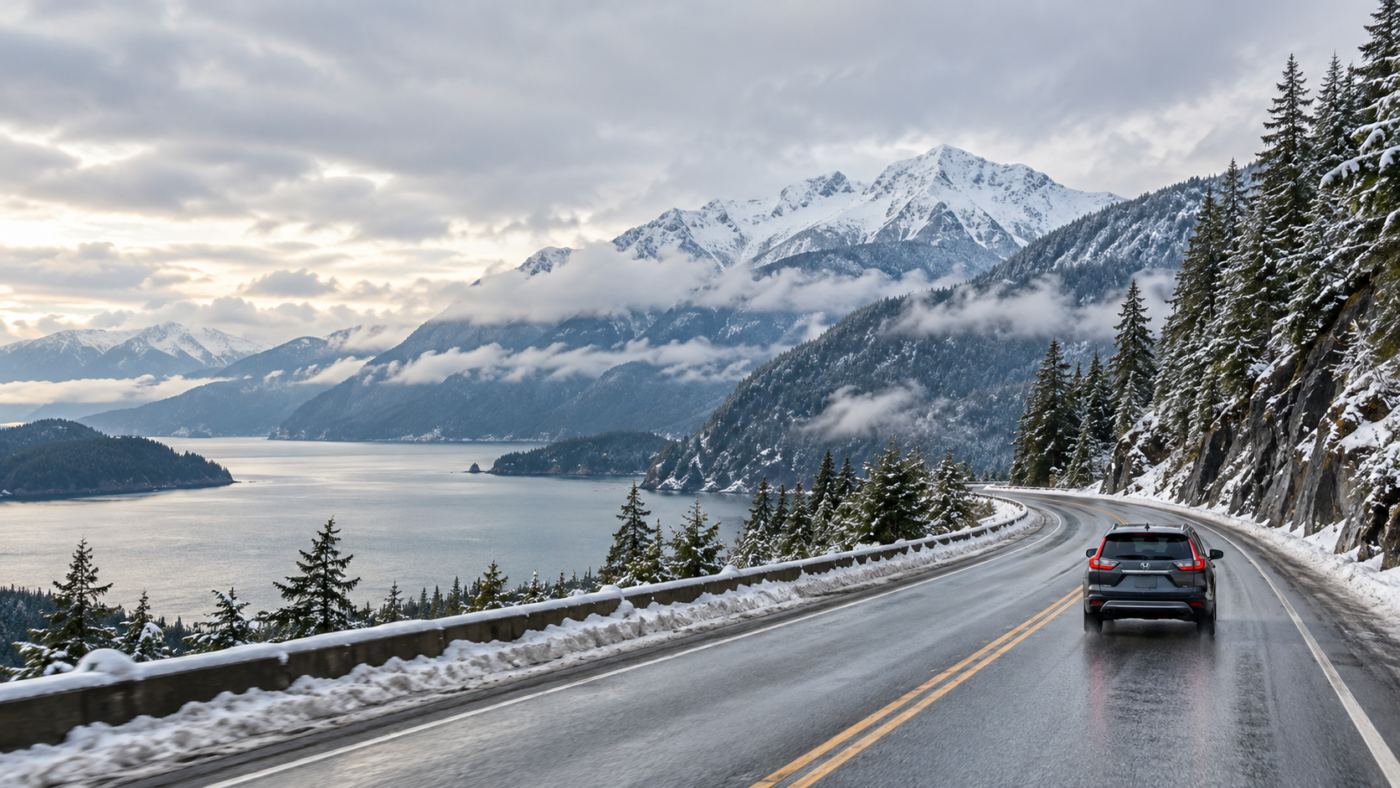
Winter in British Columbia does not always begin with heavy snow. It may be raining where you live while the road ahead has colder, more difficult conditions. Before you drive, check both your route and your vehicle.
When are winter tires required?
Starting October 1, winter tires are required on certain signed highways in British Columbia. The requirement does not apply to every city street, and the end date varies by route.
The Sea to Sky Highway toward Squamish is one example. Its mandatory winter tire zone begins just north of Horseshoe Bay. According to the Squamish RCMP, the requirement there runs from October 1 to March 31. Before travelling elsewhere, check the posted signs and the province’s map of designated routes.
Under B.C.’s rules, a winter tire does not necessarily need the mountain and snowflake symbol. A tire marked M+S (Mud and Snow) also meets the legal definition if it has at least 3.5 mm of tread depth. If you regularly drive in snow and ice, however, ICBC recommends tires with the mountain and snowflake symbol for better traction in more demanding conditions.
What tires do you need for a road test?
In our experience, a road test vehicle does not usually need tires with the mountain and snowflake symbol. An all-season tire marked M+S may be accepted, provided the tires are in safe condition and suitable for the conditions that day. ICBC can refuse a vehicle with unsafe tires, and the final decision about whether a vehicle is acceptable for a road test rests with ICBC.
Do not assume a road test will automatically go ahead or be cancelled when it snows. Our instructors have seen some Class 7 tests cancelled on snowy days, while some Class 5 and Class 4 tests went ahead after road conditions were assessed. This is our experience, not a fixed rule for each licence class. If the weather is poor, confirm the status of your appointment with ICBC before leaving.
Walk around your vehicle before driving
A quick walk around the vehicle is a useful habit before any trip. Look at the visible condition of the tires, check for obstacles or damage, and notice any new scratches. In winter, clear snow and ice from the windows, mirrors and lights so you can see clearly and other road users can see you.
Check that your vehicle insurance is current, especially if you plan to use your own vehicle for a road test. ICBC requires a safe, insured vehicle and may refuse one with unsafe tires, faulty lights or windows that do not meet its requirements. You can review ICBC’s road test vehicle checklist before your appointment.
We also recommend checking your vehicle’s fluid levels once a week, following the owner’s manual. Keep an eye on the windshield washer fluid in winter. Check tire pressure regularly too, as it can drop when temperatures fall.
Adjust your driving to the conditions
On wet, snowy or slippery roads, slow down and leave more room to stop. Accelerate, steer and brake smoothly. Before a trip, check the road conditions and highway cameras on DriveBC. If the conditions are beyond what you or your vehicle are prepared for, consider travelling at another time.
A few minutes of preparation can make a difference: check the route, walk around the vehicle, inspect the tires and confirm your insurance before you set off. If you have a road test, confirm that it is going ahead in the day’s conditions.