
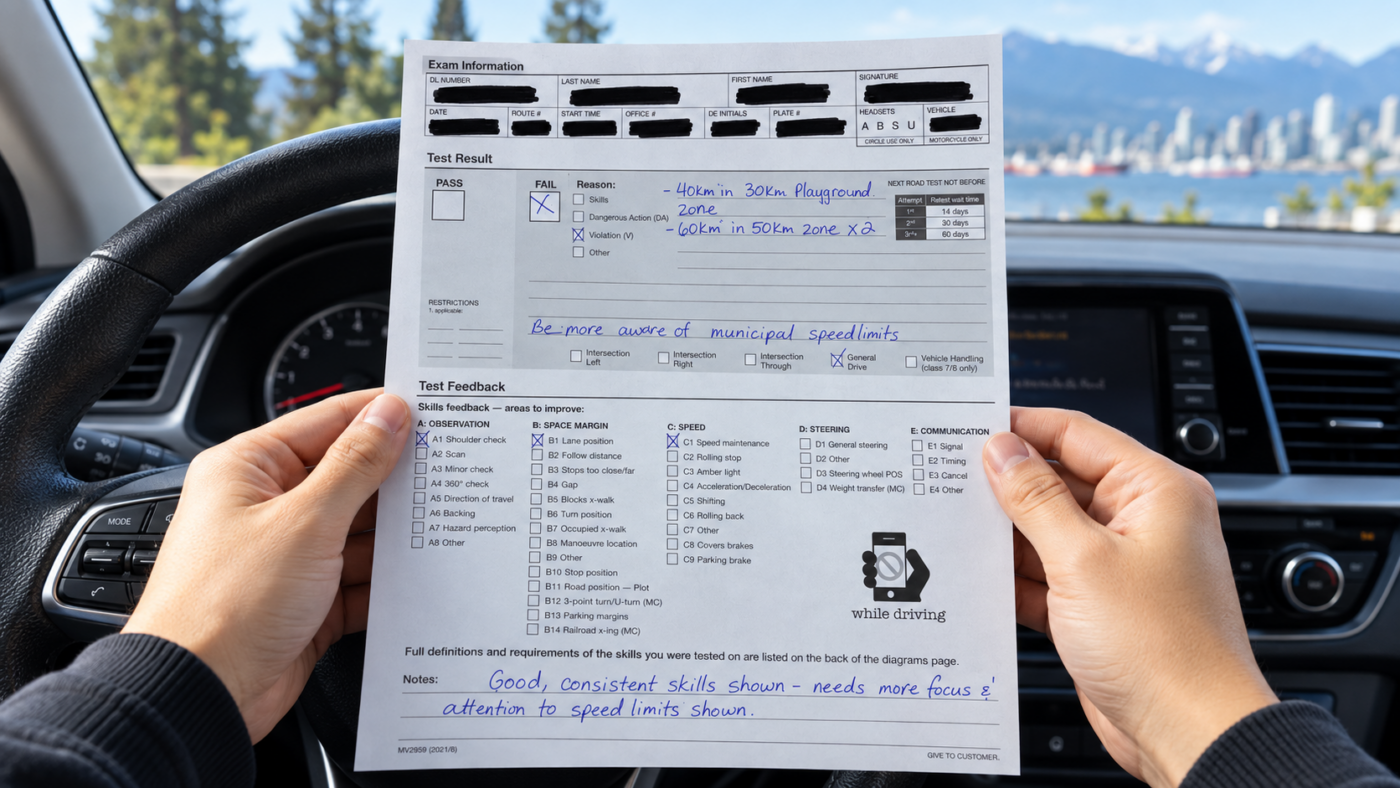
Receiving your ICBC road test results can be exciting, disappointing or sometimes confusing. Whether you passed or failed, the result sheet contains valuable feedback about your driving skills and the areas that may still need improvement.
The check marks and handwritten notes are not simply a score. They show what the examiner observed during your road test, including your observation habits, space margins, speed control, steering and communication with other road users. Understanding this feedback can help you become a safer and more confident driver.
Is the ICBC Road Test Result Sheet a Simple Scorecard?
The ICBC road test result sheet should not be read like a school exam in which every check mark has the same value. Some mistakes are relatively minor, while others may create an immediate safety risk or lead to a traffic violation.
The examiner considers your overall driving performance, how often a mistake occurs and how serious it is. This means two drivers may receive a similar number of marks but have different final results.
What Does a Checked Box Mean?
A checked box identifies a skill or behaviour that needs attention. It does not necessarily mean that one particular mistake caused you to fail.
Repeated errors may show that a driving habit has not yet become consistent. A single serious action—such as speeding in a school or playground zone, creating a dangerous situation or requiring the examiner to intervene—may also affect the final result.
The handwritten notes are especially useful because they often explain the situation more clearly. Read them together with the checked boxes to understand what happened during the test.
The Five Main Driving Skills
The feedback section is divided into five main categories:
1. Observation
This includes shoulder checks, scanning, mirror checks, 360-degree checks, direction of travel, backing and hazard perception. Good observation means noticing potential risks early and checking properly before moving or changing direction.
2. Space Margin
This category covers lane position, following distance, stopping position, safe gaps, turns, parking margins and your position around other vehicles, cyclists and pedestrians. Maintaining enough space gives you more time to react safely.
3. Speed
The examiner looks at speed maintenance, rolling stops, amber lights, acceleration, deceleration and whether you follow posted speed limits. Drivers must also recognize when the limit changes, especially near schools, playgrounds and construction zones.
4. Steering
This includes general steering control, steering-wheel position and weight transfer. Your steering should be smooth, controlled and appropriate for the situation.
5. Communication
Signals, timing and cancelling the signal are included in this category. Clear communication allows other road users to understand what you intend to do.
A Pass Can Still Include Areas to Improve
Passing the road test does not mean that every part of the drive was perfect. An examiner may still identify habits that should be improved.
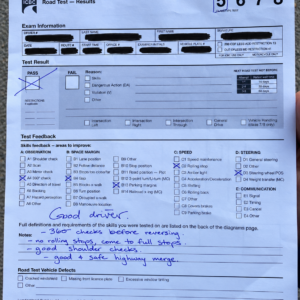
For example, one successful result sheet included positive comments such as “good driver,” good shoulder checks and a good, safe highway merge. However, the same driver was also reminded to complete a 360-degree check before reversing, avoid rolling stops, choose safer gaps and improve parking margins.
This is normal. A passing result means the driver demonstrated the required level of safety and control during the test, but the feedback should still be taken seriously. Passing is great; safe driving is better.
Why Did I Fail If I Made Only a Few Mistakes?
Many drivers are surprised when they fail despite receiving only a few marks. However, a road test is not decided simply by counting the number of checked boxes.
The seriousness of an error matters. A dangerous action, a traffic violation or a situation that requires the examiner to intervene may lead to an unsuccessful result, even when the rest of the drive is reasonably good. Repeating the same mistake can also show that a skill is not yet consistent.
Instead of focusing only on how many marks you received, consider what happened, how serious it was and whether the same error occurred more than once.
A Real Example: Good Driving, One Serious Violation
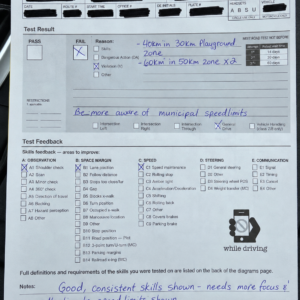
One of the unsuccessful result sheets shown in this article offers a useful example. The examiner wrote that the driver demonstrated “good, consistent skills,” but also noted that the driver needed more focus and attention regarding posted speed limits.
According to the examiner’s notes, the driver travelled at 40 km/h in a 30 km/h playground zone and failed to recognize a 50 km/h zone more than once. Although many other parts of the drive were completed well, the speed-limit violation affected the final result.
This example shows why knowing the posted speed limit is not enough. Drivers must continually scan for signs and adjust their speed as soon as the limit changes. Extra attention is especially important around schools, playgrounds, construction areas and neighbourhood streets.
What Should You Do After the Test?
Whether you passed or failed, take a few minutes to review the result sheet carefully. Do not focus only on the final result. Look at the checked boxes, read the examiner’s handwritten notes and identify any mistakes that occurred more than once.
If you passed, continue practising the areas mentioned by the examiner. Passing the test is an important achievement, but safe driving requires continued attention and experience.
If you were unsuccessful, use the feedback to create a focused practice plan. Instead of repeating the entire road test route, spend more time correcting the specific habits identified by the examiner. For example, if the sheet mentions shoulder checks, speed control or parking margins, practise those skills until they become consistent.
When Can You Retake the Road Test?
ICBC currently requires the following minimum waiting periods:
- After the first unsuccessful road test: 14 days
- After the second unsuccessful road test: 30 days
- After the third or any later unsuccessful attempt: 60 days
These are minimum waiting periods. The next available appointment may be later, depending on booking availability.
Use the waiting period wisely. Practising without understanding what went wrong may reinforce the same habits. A professional instructor can review your result sheet, observe your driving and help you work on the areas that need the most attention.
Important Change Beginning October 19, 2026
Beginning October 19, 2026, British Columbia’s Graduated Licensing Program will change. New drivers will still need to pass the Class 7 road test to move from the Learner stage to the Novice stage.
However, the second road test currently used to move from a Class 7 Novice licence toward a Class 5 licence will be removed. Eligible drivers will instead complete a Driving Record Assessment. After meeting the requirements, they can upgrade to a Class 5 licence with restrictions, including a 12-month requirement for zero blood-alcohol and zero blood-drug content while driving.
These changes do not make safe driving skills less important. Your driving record, daily habits and ability to make safe decisions will continue to matter throughout the licensing process.
Turn Your Results into a Training Plan
An ICBC result sheet is most helpful when it becomes a practical training plan. At Urban Driving Academy, we can review your road test feedback and design lessons around the specific skills that need improvement.
Whether you need help with observation, speed control, parking, highway driving, confidence or preparation for another road test, focused practice can help you avoid repeating the same mistakes.
Bring your result sheet to your next lesson, and we will help you understand the feedback and turn it into safer, more confident driving.
Urban Driving Academy
North Vancouver
Phone: 778-999-9605
Website: urbandrivingacademy.com
Drive Smart. Pass with Confidence.
Add a Comment