
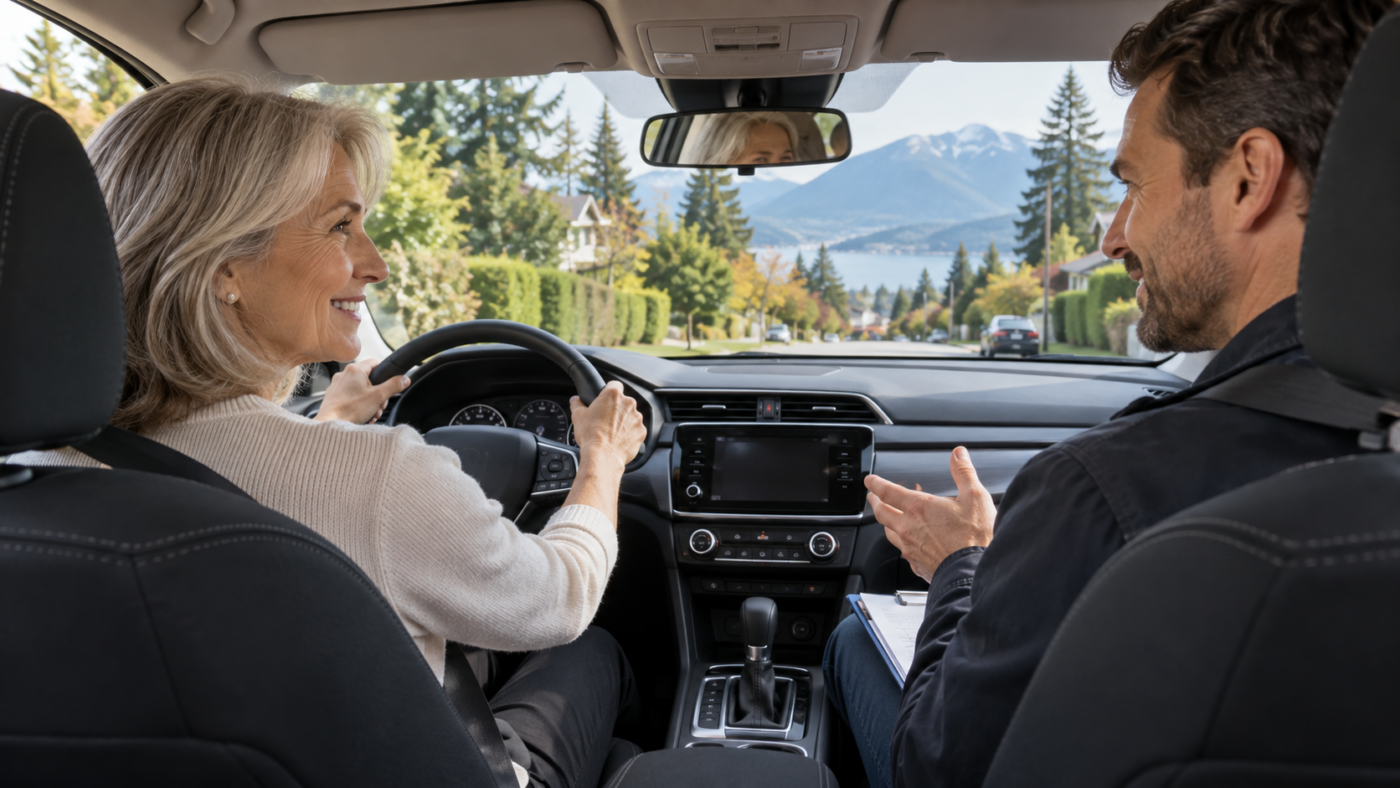
Receiving a letter requiring an Enhanced Road Assessment can feel unsettling, especially if you have been driving for many years. Knowing what to expect and practising beforehand can help you approach the assessment with greater confidence and peace of mind.
Who may be referred for an ERA?
An ERA is an on-road driving assessment conducted by ICBC for RoadSafetyBC. Drivers with a Class 5 or Class 7 licence may be referred at any age. A report from a medical professional, a collision or police report, or the results of an earlier assessment may lead RoadSafetyBC to request further evaluation. If an ERA is required, the driver receives a referral letter.
Turning 80 does not automatically mean you must take an ERA. In British Columbia, drivers must submit a Driver’s Medical Examination Report at age 80, again at 85, and every two years thereafter. If RoadSafetyBC needs further information after reviewing the report, it may refer the driver to ICBC for an ERA.
What happens on assessment day?
Allow approximately 90 minutes for the full appointment. The on-road driving portion takes about 45 minutes. Before you drive, the examiner checks the vehicle and asks you to demonstrate how to use certain safety controls. After the first part of the drive, you return to the ICBC centre and receive feedback on your driving. You then head out for the second part of the assessment. At the end, the examiner reviews your performance with you.
While driving, you may be asked to operate a vehicle control, such as the windshield wipers, headlights or defroster. You may also be asked to follow a three-step set of driving directions and retrace a short route. These are practical tasks completed during the drive; there is no computer-based memory test.
What driving tasks are included?
According to the official Enhanced Road Assessment Policy, the on-road assessment includes at least:
| Driving task | Minimum number |
|---|---|
| Right turns | 10 |
| Left turns | 10 |
| Stops | 4 |
| Driving straight through intersections | 8 |
| Lane changes | 6 |
| Changes in speed zone, such as school or playground zones | 2 |
| Parking manoeuvres | 2 |
The policy also includes:
| Task | What it involves |
|---|---|
| Operating a vehicle control | Using a control identified before the drive, such as the wipers or defroster, while driving |
| Following multi-step directions | Carrying out a three-step driving instruction |
| Retracing a route | Driving away from a starting point and finding the same route back |
| Receiving feedback | Hearing the examiner’s feedback partway through the assessment and continuing the drive |
These are minimum requirements, not a fixed route to memorize. Highway driving is not a required part of the ERA, although it may be included depending on the location.
How can Urban Driving Academy help?
We offer private ERA preparation lessons tailored to your needs. We begin by reviewing your driving and identifying the skills you would benefit from practising, such as observation, turns, intersections, lane changes and speed control.
We also help you become familiar with the assessment process. Together, we can practise using vehicle controls, following multi-step directions and responding to feedback. Most importantly, we help you feel calm and confident behind the wheel so you can demonstrate your driving ability.
Drivers with Class 1 to 4 licences may also be referred for a driving re-exam. These appointments are not offered at every ICBC location, so confirm your assessment location with ICBC when booking.
Received an ERA or re-exam referral letter? Contact Urban Driving Academy to arrange preparation suited to your needs.